
Meet the City of Victoria Police, TX
The Victoria Police Department serves 65,000 residents in Victoria, Texas, but their daytime traffic tells a different story. With 100,000 people moving through the city daily, this crossroads community earned its nickname honestly. The department’s 126 licensed officers and 40 civilian staff handle one of the region’s busiest police operations. When highways converge, and major metropolitan areas surround you, every minute counts. But their records system was stuck in another decade, costing them hours they couldn’t afford to lose.
Daily Detour: Hours Lost, One Page at a Time
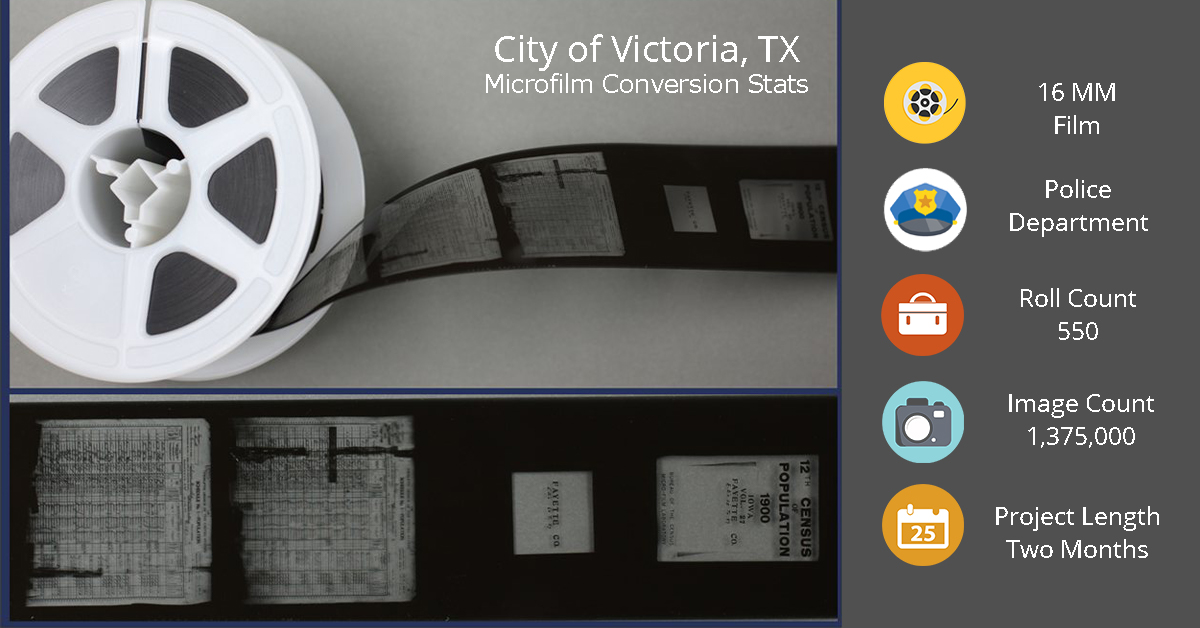
Victoria Police Department’s records supervisor, Lauren Meaux, faced a problem that grew worse each day. The department stored more than 550 rolls of 16mm microfilm containing 1,375,000 images of critical police records. Staff members needed these documents to respond to requests, support investigations, and serve their community. But accessing them meant scrolling through film image by image. Finding a single record could take hours.
Printing reports? Even worse. Some documents required printing one page at a time, keeping staff members anchored to microfilm readers for hours when they should have been handling more urgent priorities.
“Scrolling image by image to find a record, and only having the capability to print one page at a time was incredibly time-consuming and took our staff away from more important issues,” Meaux explained. “Some reports could take hours to print.”
The microfilm collection sat locked in the records division. Detectives investigating cold cases had to wait for someone to unlock the room. Dispatch couldn’t access files from their stations. Every records request created a bottleneck. The department had the information their teams needed, but the format made it nearly impossible to use efficiently. With traffic incidents, investigations, and public records requests flooding in daily, Victoria PD needed their archives to work as hard as their officers.
About our Client
CLIENT NAME:
CHAMPION:
Lauren Meaux
Records Supervisor
POPULATION:
est. 65,000 residents
With more than 550 rolls of 16MM microfilm to search through, they needed a better way to find and print records.
The Solution: From Film Rolls to Instant Access
Victoria Police Department turned to MCCi for professional scanning services to convert their massive microfilm collection into searchable digital records. The IT Department had worked with MCCi before and trusted the partnership. That trust mattered when handling decades of police records.
MCCi’s team handled the logistics. They picked up boxes of microfilm reels directly from the department, eliminating the need for staff to transport hundreds of pounds of archives. The conversion project began in April with a large batch to test the process and work out any issues. A second round followed in May. The team knew these documents were old, some showing their age after decades of storage. MCCi enhanced each image to ensure legibility and print quality, giving Victoria PD clear, usable records.
The digitized records went straight into the department’s Laserfiche repository. For typed reports, optical character recognition technology made every word searchable. What once required hours of scrolling through film now took seconds with a quick search. Staff could select page ranges and print entire reports in minutes instead of hours.
“Now that it’s digital, we can select a page range of records and print easily,” Meaux said. “If the records were typed, the digitization process applied optical character recognition and it made it very easy to search for records now with a quick search in our Laserfiche repository.”
Victoria PD sent 60 additional reels after the initial conversion to complete their contract. They still have approximately 500 reels to convert, but they prioritized the records accessed most frequently. The ones they need once or twice a week are now digital. The rest, accessed only occasionally, can wait.
The Results: Immediate Operational Improvements
Victoria Police Department’s digital records delivered immediate operational improvements. Response times to records requests dropped significantly. Detectives working cold cases gained desktop access to historical files without waiting for the records division to unlock microfilm storage. Dispatch can now pull documents from their stations instead of making trips across the building.
“Our response to our requests is much faster,” Meaux noted. “Our detectives that work cold cases now have access at their desk, and they no longer have to wait for our department to be available to unlock these records. They also don’t have to waste two to three hours of their day coming to our office to accomplish what they need.”
The department now manages retention schedules more effectively within Laserfiche. Some records require five years of storage. Others stay permanently. With digital capacity, Victoria PD can maintain records indefinitely when needed without worrying about physical storage constraints or deteriorating film.
Staff time redirected from microfilm searches now supports more critical police operations. Officers and civilian staff focus on serving their community instead of fighting outdated technology. The locked records room no longer creates access barriers. Information flows to the people who need it, when they need it.
“MCCi was super helpful, we had a conference call to walk through the entire process,” Meaux said about working with MCCi’s team. “The documents we have are very old, and they did everything they could to enhance the images to make them legible and print-friendly.”
The conversion project proves that legacy records don’t have to limit modern police work. Victoria Police Department turned 1,375,000 archived images into accessible, searchable digital records. Their officers save hours each week. Their community gets faster service. And their decades of police records work in their favor rather than against them.
Say Goodbye to microfilm readers
Imagine finding any document in 30 seconds instead of scrolling through microfilm and microfiche on old machines. Digital search beats manual hunting every time. Digitizing records frees up square footage for productive use and cuts overhead costs.